
What You’ll Learn in This Article
- Shikoku is about 3.5 hours from Osaka by highway bus — no transfers required to Takamatsu
- Plan A (Kagawa): fresh udon, Ritsurin Garden, and Kotohira-gu Shrine in 2 days
- Plan B (Ehime): Dogo Onsen hot spring, Matsuyama Castle, and optional Shimanami Kaido cycling
- Cost breakdown and transport options compared for both plans
- Optional add-ons: Naoshima Island art, Naruto whirlpools, or Kochi coastline
What Changes When You Add 2 Days to Osaka
Shikoku is roughly 3.5 hours from Osaka by highway bus (to be verified) — a direct ride with no transfers.
After Osaka, most travelers default to Kyoto or Nara. Both are worth visiting, but if you have two days to spare, Shikoku offers something harder to find: spaces that aren’t yet overrun, food that hasn’t been softened for tourist palates, and a pace that still belongs to the locals.
This page presents two model itineraries from Osaka. Plan A centers on Kagawa and Takamatsu — udon, a classical garden, and a famous hilltop shrine. Plan B heads to Matsuyama in Ehime for one of Japan’s oldest hot spring towns and a mountain castle.
Info
Multiple bus companies operate the Osaka–Takamatsu route. Book early and fares can drop to around ¥2,000 (approx. USD 14) one way (to be verified).
Plan A: Udon & Konpira-san (Kagawa / Takamatsu)
Takamatsu makes a compact base: udon shops, Ritsurin Garden, and Kotohira-gu Shrine are all within easy reach, and the distances between them keep moving time short.
Day 1: Osaka → Takamatsu → Udon Crawl → Ritsurin Garden
Step off the bus and head straight for udon. Sanuki noodles have a firm, springy bite and a lighter dashi broth than what you’d find in Osaka — the difference is noticeable from the first bowl.
- Highway bus from Osaka Umeda (Hankyu Sanbangai terminal, etc.) to Takamatsu Station — approx. 3.5 hours (to be verified)
- On arrival, try the self-service style at a counter udon shop — Sakae-eda opens from around 7 a.m. and is a short walk from the station
- Visit 2–3 udon shops over the morning; total cost is typically around ¥1,000 (approx. USD 7)
- Afternoon: Ritsurin Garden — entry ¥410 (approx. USD 3)
- Allow 1–2 hours to walk both the south and north gardens
Point
At self-service udon shops (known as セルフ式), you pick up your noodles, briefly rinse them in hot water yourself, then ladle on the broth. Tempura toppings are usually displayed beside the counter. The process is intuitive even on your first visit.
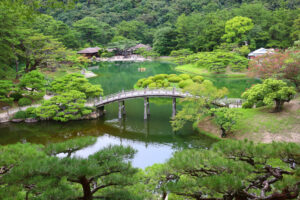
Ritsurin Garden is a feudal-era stroll garden maintained since the Edo period. Carefully pruned pine trees frame views over the central pond, and in late afternoon the light reflects off the water in a way that makes the garden feel unusually still.
Stay overnight in Takamatsu to set up an early start the next morning.
Day 2: Kotohira-gu Shrine → Back to Osaka
Kotohira-gu — informally called Konpira-san — sits about an hour from Takamatsu. The 785 stone steps to the main hall climb steadily through cedar forest, opening to a wide view of the Sanuki Plain at the top.
- Kotoden Kotohira Line from Takamatsu to Kotoden-Kotohira Station — approx. 62 minutes
- Main hall (Gohongu): 785 steps, about 40 minutes at a steady pace
- Inner shrine (Okushi): an additional 583 steps — total 1,368, about 1 hour 20 minutes extra
- After the visit, browse the stone-flanked approach for bekko (tortoiseshell candy) and wasanbon sugar confections
- Return to Osaka by afternoon bus or JR, or continue to your next destination
Plan B: Dogo Onsen & Matsuyama Castle (Ehime / Matsuyama)

Matsuyama is reached by Shinkansen to Okayama, then the limited express Shiokaze — about 3.5 hours total from Shin-Osaka. Dogo Onsen, one of Japan’s oldest hot spring districts, is the anchor of this itinerary.
Day 1: Osaka → Matsuyama → Dogo Onsen
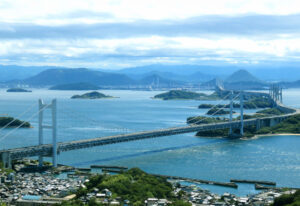
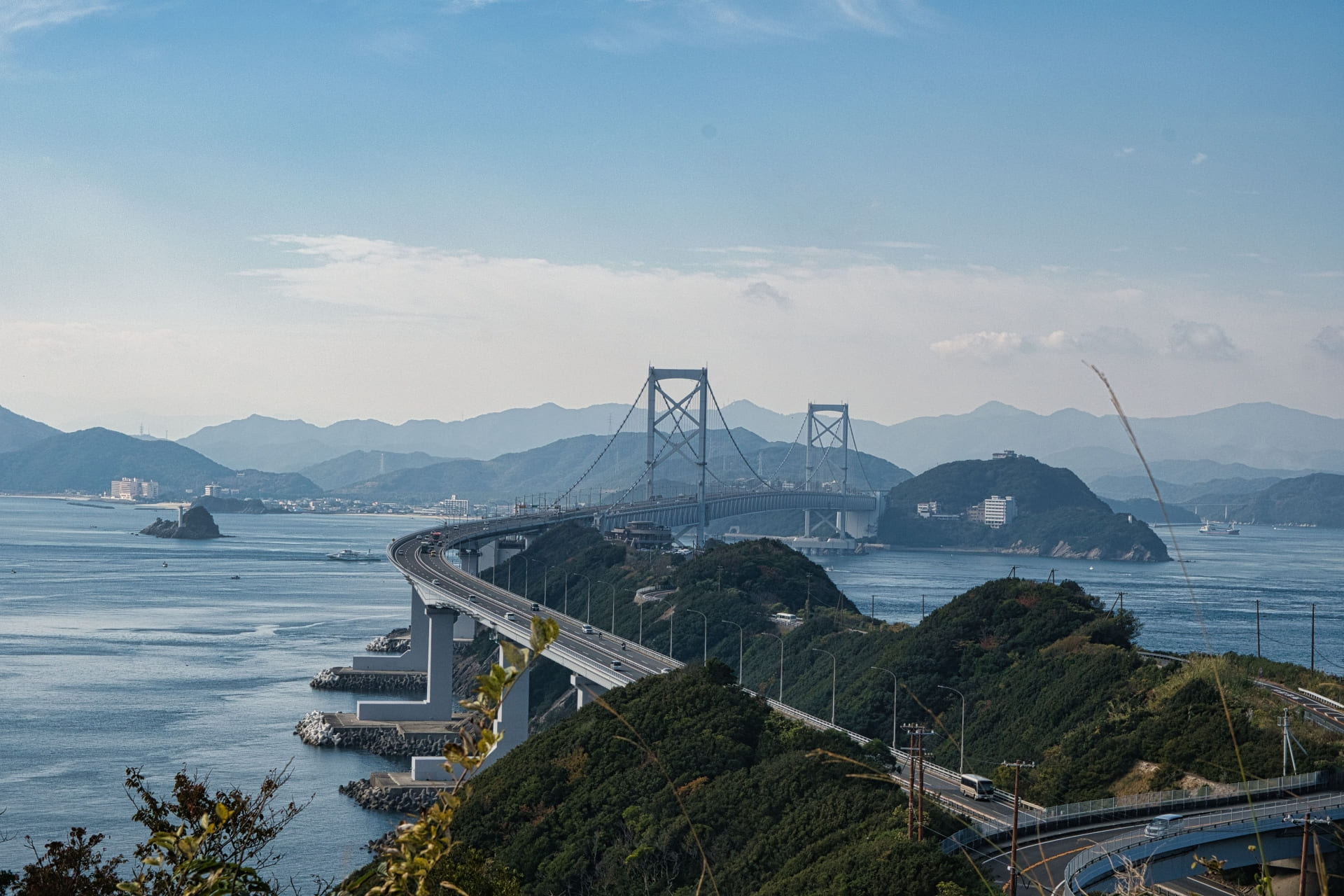
The train ride itself is part of the appeal: Shiokaze crosses the Seto Inland Sea bridges, giving views over scattered islands before arriving on Shikoku.
- Shin-Osaka to Okayama: Shinkansen (Nozomi or Hikari) — approx. 50 minutes
- Okayama to Matsuyama: limited express Shiokaze — approx. 2 hours 40 minutes
- City tram from Matsuyama Station to Dogo Onsen — about 20 minutes; the main bathhouse is a short walk from the terminal
- Dogo Onsen Honkan: Kami-no-Yu lower hall — ¥700 (approx. USD 5), open 6:00–23:00
- Dinner and overnight in the Dogo Onsen area
Info
Dogo Onsen Honkan completed its preservation restoration in July 2024 and is fully open as of March 2026. All bathing areas are operating normally.
Day 2: Matsuyama Castle → Shimanami Kaido or Back to Osaka
In the morning, a ropeway carries you up to Matsuyama Castle in a few minutes. From the keep, the city spreads below and the Seto Inland Sea appears on clear days.
- Ropeway round trip ¥520 (approx. USD 4) + castle entry ¥520 — total ¥1,040 (approx. USD 7)
- Ropeway operates from 8:30 a.m. (hours vary by season)
- Shimanami Kaido option: JR to Imabari — approx. 35 minutes — then rent a bicycle and cross the island bridges toward Onomichi
- Return to Osaka: limited express Shiokaze + Shinkansen — approx. 3.5 hours
Plan B relies heavily on Shinkansen and limited express trains. If you have a Japan Rail Pass, the Osaka–Matsuyama journey — including Shiokaze — is covered at no extra cost (to be verified). Run the numbers before you buy.
Cost Comparison (Per Person, Round Trip)
The table below compares the main costs for both plans. Accommodation figures are based on a mid-range hotel and vary by season and booking timing.
| Item | Plan A (Kagawa / Takamatsu) | Plan B (Ehime / Matsuyama) |
|---|---|---|
| Round-trip transport from Osaka | Highway bus: ~¥2,000–4,000 (USD 14–28) × 2 (to be verified) | Shinkansen + limited express: ~¥12,000–14,000 (USD 83–97) × 2 (to be verified) |
| Accommodation (1 night) | ~¥6,000–12,000 (USD 41–83) | ~¥8,000–15,000 (USD 55–104) — onsen ryokan tend to be higher |
| Main sightseeing costs | Udon ~¥1,000 + Ritsurin Garden ¥410 | Dogo Onsen ¥700+ + Matsuyama Castle ¥1,040 |
| Estimated total | ~¥12,000–25,000 (USD 83–173) | ~¥35,000–45,000 (USD 242–311) |
Point
Plan A fares vary significantly by bus company and how early you book. For Plan B, a Japan Rail Pass covers the Shinkansen and limited express at no extra charge — confirm coverage before purchasing (to be verified).
If You Have More Time: Optional Add-Ons
With a third day or more, Shikoku and the surrounding Seto Inland Sea open up further.
- Naoshima (art island): ferry from Takamatsu Port — about 1 hour. Home to Chichu Art Museum and the Art House Project
- Naruto (Tokushima): best in spring and summer for the tidal whirlpools. About 1 hour from Takamatsu by highway bus (to be verified)
- Kochi & Katsurahama: Tosa history and a long Pacific coastline — easy to fold into a cross-Shikoku route
- Shimanami Kaido cycling (1–2 days): the ~70 km (43 mi) route between Imabari and Onomichi is manageable for beginners with an overnight stop
Summary
Two extra days from Osaka is enough time to reach Shikoku and experience something genuinely different — udon eaten at a counter with locals, stone steps worn smooth by centuries of pilgrims, or a hot spring that predates most of Japan’s famous tourist sites.
- Osaka to Takamatsu: ~3.5 hours by highway bus. Choose Plan A to keep costs low
- Osaka to Matsuyama: ~3.5 hours by Shinkansen + limited express. Choose Plan B for hot springs and a castle
- Both plans cover the main highlights comfortably within 2 days
- Japan Rail Pass holders get the most value from Plan B — Shinkansen and Shiokaze are both included (to be verified)
- Optional extensions: Naoshima, Naruto, or Shimanami Kaido cycling