What You’ll Learn in This Article
- Five criteria used to rank each destination for car-free travel: transit clarity, station-to-spot effort, walkable area coverage, feasibility in 1–2 days, and beginner-friendliness
- For all 10 ranked destinations: the specific transport options and travel times that make car-free travel practical
- Destination-by-destination breakdowns with links to full guides where available
- How to choose by travel style: tram cities, walk-everywhere towns, and transit-hub options
How We Define ‘Car-Free Friendly’
Being close to sightseeing spots alone doesn’t make a destination comfortable to visit without a car. We ranked each place against five criteria.
| Criterion | What It Measures | Why It Matters |
|---|---|---|
| Transit clarity | How straightforward the routes, boarding, and transfers are | Confusion burns time and lowers the quality of the experience |
| Station/port to major sights | Travel time, number of transfers, walking distance from the hub | Getting around after arrival is where most effort is spent |
| Walkable coverage | Share of key sights reachable on foot without any transit | The less transit required, the fewer things can go wrong |
| 1–2 day feasibility | Whether the main sights can be covered comfortably in one or two days | Checks whether the destination is dense enough to work without a car |
| Beginner-friendliness | Can first-time visitors navigate it with limited information? | Destinations where missed connections and surprise closures are less likely rank higher |
Quick Comparison: 10 Car-Free Destinations at a Glance
All 10 destinations compared by main transport, travel time from the station or port, and beginner rating. More stars = easier.
| Rank | Destination | Main Transport | From Station/Port to Major Sights | Beginner Rating | Full Guide |
|---|---|---|---|---|---|
| #1 | Hakodate (Hokkaido) | City tram (streetcar) | 5–15 min | ★★★★★ | Available |
| #2 | Kanazawa (Ishikawa) | Sightseeing loop bus | 5–15 min | ★★★★★ | Available |
| #3 | Kurashiki (Okayama) | Walking | 10–15 min from JR Kurashiki Stn. | ★★★★★ | Available |
| #4 | Matsuyama (Ehime) | City tram (streetcar) | 10–20 min | ★★★★☆ | Available |
| #5 | Takamatsu (Kagawa) | Bus / Kotoden railway | 10–20 min | ★★★★☆ | Available |
| #6 | Naoshima (Kagawa) | Walking / bicycle | Walkable from port | ★★★☆☆ | Available |
| #7 | Izumo Taisha & Matsue (Shimane) | Bus / Ichibata Electric Railway | 25–40 min | ★★★☆☆ | Available |
| #8 | Nagasaki (Nagasaki) | City tram (streetcar) | 5–20 min | ★★★★★ | Coming soon |
| #9 | Nara (Nara) | Walking | 15–30 min from Kintetsu/JR Nara Stn. | ★★★★★ | Coming soon |
| #10 | Matsumoto (Nagano) | Walking | 15–20 min from JR Matsumoto Stn. | ★★★★☆ | Coming soon |
Info
If you plan to combine multiple destinations on this list by JR, a JR Pass can offer good value. It’s easiest to purchase before arriving in Japan.
#1 Hakodate (Hokkaido) | All Major Sights Connected by a Single Tram Line
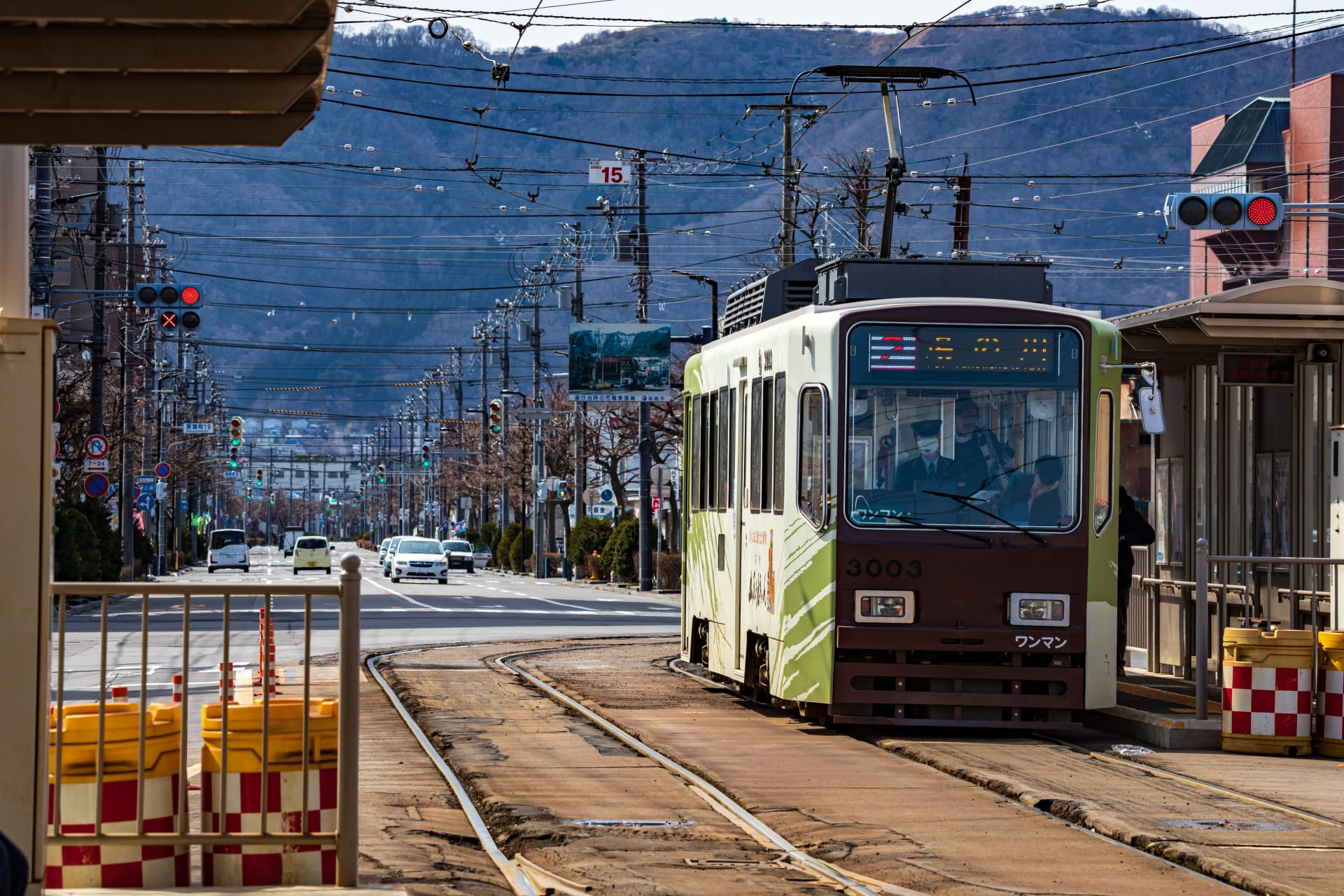
Hakodate’s city tram network covers almost all tourist areas along a single line. A one-day pass (¥600 / approx. USD 4, to be verified) is all you need to move around the city.
Hakodate Morning Market is a 5-minute walk from Hakodate Station. Kanemori Red Brick Warehouse is right by the ‘Juujigai’ tram stop. The ropeway up to Hakodate Mountain’s night view is a 15-minute walk from ‘Juujigai’ — or you can take the direct evening bus (to be verified).
Goryokaku Fort is a 15-minute walk from the ‘Goryokaku Koen Mae’ tram stop. Yunokawa Onsen is at the end of the line — just ride all the way. A natural itinerary is to visit the main sights on day one and spend the following morning relaxing at a hot spring inn.
Info
The one-day tram pass costs ¥600 (approx. USD 4, to be verified). A single ride is ¥140 (approx. USD 1), so the day pass saves money from the fourth ride onward (to be verified). Available at major stops including in front of Hakodate Station, or on board the tram.
For a full 2-day Hakodate itinerary and tram guide, see our <a href=”https://japanskybridge.com/hakodate-no-car-guide/”>Hakodate Car-Free 1-Night 2-Day Guide</a>.
#2 Kanazawa (Ishikawa) | A Tourist Bus Designed to Cover Every Key Sight
Kanazawa has a dedicated sightseeing route called the ‘Jokamachikinazawa Shuyu Bus’ (Castle Town Kanazawa Loop Bus), linking Kenroku-en Garden, Kanazawa Castle, Higashi Chaya District, Omicho Market, and the 21st Century Museum of Contemporary Art on a single route.
A free-ride day pass costs ¥800 (approx. USD 5, to be verified). Board at JR Kanazawa Station and hop on and off at each sight. Buses run frequently during tourist hours (to be verified), so you won’t spend long waiting for the next one.
Higashi Chaya District’s cobbled lanes are picturesque on their own. Omicho Market is best early in the morning — fresh seafood and fewer crowds. A typical Kanazawa rhythm is 15–30 minutes at each spot, then back on the bus for the next.
Point
Regular Hokutetsu Bus routes also run parallel to the loop, but first-time visitors are better off sticking to the dedicated sightseeing loop to avoid confusion.
For a full 2-day Kanazawa itinerary, bus guide, and budget breakdown, see our <a href=”https://japanskybridge.com/kanazawa-no-car-guide/”>Kanazawa Car-Free 1-Night 2-Day Guide</a>.
#3 Kurashiki Bikan Historical Quarter (Okayama) | 15 Minutes from the Station, No Transit Needed
Kurashiki’s biggest advantage is that you don’t need to board anything. It’s a 10–15 minute walk from JR Kurashiki Station to the Bikan Historical Quarter, and Ohara Museum of Art, Ivy Square, and the whitewashed canal district are all within easy walking distance.
The Bikan historical area spans a compact roughly 1 km east-west and 500 m north-south. Walk along the canal, stop into galleries and craft shops, enjoy a local Japanese lunch, then spend the afternoon at Ohara Museum of Art. That alone makes a full, satisfying day.
From Okayama Station, it’s about 20 minutes by JR Sanyo Main Line (to be verified), so Kurashiki also works as a day trip from Okayama. Visitors who feel one night isn’t quite enough can extend the trip with Okayama Castle and Korakuen Garden to fill two days.
Warning
Most major facilities in the Bikan Quarter are closed on Mondays or Tuesdays. Ohara Museum of Art is closed on Mondays (or the following weekday if Monday falls on a public holiday, to be verified). Check hours before you visit.
For how to walk the Bikan Quarter, what to expect at Ohara Museum of Art, and where to eat, see our <a href=”https://japanskybridge.com/kurashiki-bikan-guide/”>Kurashiki Bikan Historical Quarter 1-Day Guide</a>.
#4 Matsuyama (Ehime) | City Tram Connects Dogo Onsen and Matsuyama Castle
Matsuyama’s Iyotetsu streetcar network (city tram) links stops near Dogo Onsen and Matsuyama Castle in a single line. Two major attractions, one tram — a straightforward setup for first-time visitors.
Dogo Onsen Honkan is right at the ‘Dogo Onsen’ tram terminus. Matsuyama Castle is reached by ropeway or lift from near the ‘Okaido’ stop — the ascent takes about 15–20 minutes. Once you learn the tram, both sights are well within independent reach.
If you arrive by ferry at Matsuyama Kanko Port, a limousine bus connects the port to the city center (to be verified), making the transfer relatively easy to figure out.
Warning
Some bathing areas at Dogo Onsen are currently under renovation (as of 2026, to be verified). Check the official website to confirm which baths are open before you visit.
For a comparison of Dogo Onsen’s three bathing facilities, admission prices, and access, see the <a href=”https://japanskybridge.com/dogo-onsen-guide/”>Dogo Onsen Complete Guide</a>. For Matsuyama Castle’s ropeway, admission, and walking-route options, see the <a href=”https://japanskybridge.com/matsuyama-castle-guide/”>Matsuyama Castle Complete Guide</a>.
#5 Takamatsu (Kagawa) | Sanuki Udon and Ritsurin Garden Within Easy Reach
Sanuki udon shops cluster near Takamatsu Station, and Ritsurin Garden is about 10–15 minutes by bus. Whether you arrive by JR Marine Liner from Okayama (about 1 hour), highway bus, or ferry, the tourist core sits within comfortable reach of the station.
Ritsurin Garden is a 10-minute walk from JR Ritsurin Koen Kitaguji Station (to be verified), or accessible by city bus from Takamatsu Station (to be verified). The garden is large, but the highlights concentrate in the south garden — the main circuit takes 2–3 hours to walk.
Takamatsu has several self-service udon shops, many of which open early in the morning. A natural day: morning in Ritsurin Garden, udon for lunch, then an afternoon ferry to Naoshima — all without a car.
For full details on Ritsurin Garden’s highlights, admission, and how to get there, see the <a href=”https://japanskybridge.com/ritsurin-garden-guide/”>Ritsurin Garden Complete Guide</a>.
#6 Naoshima (Kagawa) | An Island Where Cars Simply Aren’t Needed
Since Naoshima is an island, there’s no reason to bring a car. Once you step off the ferry at Miyanoura Port, you move by foot, rental bicycle, or shuttle bus to reach the museums. Car-free travel is the default mode here.
The ferry from Takamatsu Port takes about 1 hour; from Uno Port (Okayama) it’s about 20 minutes (to be verified). Shuttle buses run to Chichu Art Museum, Lee Ufan Museum, and the Benesse House area, so the main facilities are reachable even without a bicycle.
The ★3 rating reflects two practical constraints: you need to check ferry timetables in advance, and some museums require online reservations. Walking in and accessing every facility on the same day isn’t guaranteed — particularly during peak periods (to be verified).
Warning
Chichu Art Museum, Lee Ufan Museum, and some other facilities operate on a fully advance reservation system. Once your travel dates are set, book online as early as possible (to be verified).
For Naoshima’s ferry schedule, museum reservation tips, and a full 1-day itinerary, see our <a href=”https://japanskybridge.com/naoshima-art-guide/”>Naoshima Art Day Guide</a>.
#7 Izumo Taisha & Matsue (Shimane) | Two Cities on One Public Transit Route
Izumo Taisha Shrine and Matsue Castle sit in adjacent areas. Combining buses and trains makes it possible to cover both cities without a car, though the route involves multiple transfers — plan it in advance.
To reach Izumo Taisha, take an Ichibata Bus from JR Izumo-shi Station (about 30 minutes, to be verified), or use the Ichibata Electric Railway with a transfer (about 40–50 minutes, to be verified). Around Matsue Castle, the ‘Matsue Lake Line’ sightseeing bus connects the castle, samurai residence, and Lafcadio Hearn’s former home (to be verified).
The sunset view over Lake Shinji can be seen from a terrace near Matsue Station — entirely walkable. A 3-day itinerary, one day at Izumo Taisha and one day in Matsue, is the most manageable structure.
For the full transport route, budget, and model itinerary for Izumo Taisha and Matsue, see our <a href=”https://japanskybridge.com/izumo-matsue-no-car-guide/”>Izumo Taisha & Matsue Car-Free Itinerary</a>.
#8 Nagasaki (Nagasaki) | 5 Tram Lines Cover Every Major Attraction
Nagasaki’s tram system runs 5 lines with stops within walking distance of Glover Garden, Dejima, Peace Park, Meganebashi Bridge, and the former Chinese district. The flat fare is ¥140 (approx. USD 1, to be verified), IC cards are accepted (to be verified), and the system is very easy to use.
A one-day pass costs ¥600 (approx. USD 4, to be verified). With roughly one transfer, the network covers the whole city — making it comparable to Hakodate in simplicity. Glover Garden and Dejima involve some hills, but the tram itself is easy to navigate.
The night view from Mt. Inasa is accessible by ropeway or public bus (to be verified). Ranked alongside Hakodate and Kobe as one of Japan’s ‘Three Great Night Views,’ it’s worth planning for a clear evening.
Info
A full car-free guide to Nagasaki is currently in preparation. For up-to-date travel information, check the City of Nagasaki Tourism website (to be verified).
#9 Nara (Nara) | Every Major Sight Within 30 Minutes’ Walk from the Station
From Kintetsu Nara Station or JR Nara Station, Todai-ji Temple, Kasuga Taisha Shrine, Nara Park, and Kofuku-ji Temple are all within 15–30 minutes on foot. If you have the energy, the entire day can be done without boarding anything.
The deer in Nara Park roam freely at no charge. Todai-ji Great Buddha Hall (admission ¥1,000 / approx. USD 7, to be verified) and Kasuga Taisha (inner shrine admission extra, to be verified) are the main paid sights. The area is dense enough to fill a full day.
From Osaka Namba, the Kintetsu Nara Line takes as little as 36 minutes (to be verified), so Nara works well as a day trip from Osaka or Kyoto. If you stay overnight, ryokan and hotels in Nara city offer a quieter, more local experience.
Warning
Nara’s deer are wild animals. Feed them only ‘shika senbei’ (deer crackers) — not regular food. If you’re carrying bags or food, they may approach or charge, so be mindful of your belongings.
#10 Matsumoto (Nagano) | A National Treasure Castle 15 Minutes from the Station
Matsumoto Castle (a National Treasure) is about a 15–20 minute walk from JR Matsumoto Station. The cafes and craft shops along the Metoba River are in the same area, making it easy to spend a full half-day or longer on foot.
Matsumoto Castle, the Nawate-dori shopping street, and Matsumoto City Museum of Art (featuring works by Yayoi Kusama) are all within walking distance of the station. Local Shinshu cuisine — soba noodles and game-meat dishes — is available throughout the city, rounding out a 2-day stay.
From Nagano (Hokuriku Shinkansen), it’s about 50–60 minutes by Shinonoi Line (to be verified). From Shinjuku (Tokyo), the Azusa Limited Express takes about 2 hours 30 minutes (to be verified).
Info
The castle keep has steep, narrow stairs — watch your footing and be careful of heights. During peak season, entry queues can run long. Arriving early is recommended (to be verified).
Summary: Choose Your Destination by Travel Style
Looking across all 10 destinations, two types stand out as best suited for car-free travel: cities with streetcar lines, and cities where the tourist core is compact enough to walk from the station.
- First car-free regional trip → Hakodate, Kurashiki, or Nara (simple transit, wide walkable coverage)
- Want 1–2 nights of immersive sightseeing → Kanazawa, Matsuyama, or Izumo Taisha + Matsue (high sight density, full guides available)
- Want to experience a city entirely on trams → Hakodate or Nagasaki (easy to board, hard to go wrong)
- Art or culture focused → Naoshima or Kanazawa (clear purpose makes planning easier)
- Day trip from Tokyo or Osaka → Nara (36 minutes from Osaka Namba by Kintetsu, to be verified)
Traveling without a car isn’t a constraint — it’s a filter that reshapes how you choose your destination. We hope this ranking gives you useful criteria for planning your next trip.